
A wrong generator choice triggers costly downtime. Manufacturing facilities lose $260,000 per hour, and healthcare facilities lose over $600,000 per hour during outages. Evaluate power requirements, costs, installation, and support upfront. This industrial diesel generator buying guide helps you secure a reliable, cost-effective investment. Lehui delivers robust, fuel-efficient units with strong after-sales support.
Calculate your total power needs carefully to avoid costly downtime.
Choose the right generator size to prevent efficiency losses and failures.
Evaluate all costs and support options for a reliable long-term investment.
Every reliable generator purchase starts with an accurate load study. You cannot size a unit, compare prices, or plan an installation until you know exactly how much power your facility draws. A vague estimate here creates problems everywhere else. Lehui application engineers routinely help buyers build a complete load profile before any model selection begins, and you should follow the same disciplined approach.
Start by listing every load in your facility by category: production motors, HVAC, lighting and receptacles, process equipment, and auxiliary systems. Sum these figures to get your Total Connected Load in kW. A mid-size plant might show 450 kW of motors, 200 kW of HVAC, 80 kW of lighting, 150 kW of process equipment, and 70 kW of auxiliaries, for a connected total of 950 kW.
Connected load is not the same as actual demand. Apply a diversity factor, typically 0.70–0.85 for industrial facilities, to reflect the reality that not every load runs at once. At 0.75, the 950 kW connected load becomes 712.5 kW of demand. Next, add the starting surge of your largest motor separately from the running load. A 150 HP motor with Code B starting draws roughly 598 kW at startup; subtract its running load of about 95 kW, and you add a net 503 kW. That brings peak demand to 1215.5 kW. Apply a 10% safety margin plus 20–25% for future growth, and you land near 1337 kW — which points to a 1500 kW generator.
Keep your units consistent throughout. Real power (kW) and apparent power (kVA) relate through the power factor, and mixing them up is one of the most common sizing errors.
|
Quantity |
Formula |
Example |
|---|---|---|
|
Apparent Power (kVA) |
Real Power (kW) / Power Factor |
400 kW / 0.80 = 500 kVA |
|
Real Power (kW) |
kVA × Power Factor |
1000 kVA × 0.8 = 800 kW |
|
Diversity-adjusted demand (kW) |
Total Connected kW × Diversity Factor |
750 kW × 0.75 = 562.5 kW |
|
Required Generator kW |
(Connected kW × Diversity Factor) + Largest Motor Starting kW |
(750 × 0.75) + 150 = 712.5 kW |
|
Corrected kVA after PF correction |
kW / corrected Power Factor |
400 kW / 0.95 = 421 kVA |
Power factor deserves special attention because it silently consumes generator capacity. Industrial facilities with substantial motor loads typically run at 0.75–0.85 power factor without correction, so 15–25% of generator capacity supplies reactive power that performs no productive work. Lightly loaded motors make this worse: a motor at 25% mechanical load may show 0.55–0.65 PF versus 0.85–0.88 at full load.
Industrial facilities with substantial motor loads typically operate at 0.75–0.85 power factor without correction, meaning 15–25% of generator capacity supplies reactive power that performs no productive work.
|
Load / Condition |
Typical Power Factor |
|---|---|
|
Motors at full load |
~0.85 |
|
Motors lightly loaded (25% load) |
0.6 or lower |
|
Motor starting (across-the-line) |
0.2–0.4 |
|
VFD-driven equipment (displacement PF) |
0.95 or better |
|
UPS / IT loads |
Near unity or leading (leading beyond ~0.9 risks AVR instability) |
|
Industrial three-phase genset nameplate rating |
0.8 |
|
Example composite facility (motors, HVAC, LED, UPS) |
~0.92 |
A generator rated 1000 kVA at 0.8 PF delivers only 800 kW of real power. Specify in kW whenever possible, and confirm the power factor basis of every quote you receive. Lehui publishes clear kW and kVA ratings at standard power factors, so you can compare models without hidden derating surprises.
Your facility's service voltage and phase configuration dictate what the generator must produce. Single-phase generators typically offer 120V or 240V, with dual-voltage 120/240V also available. Three-phase generators support a wider range, up to 4160V, but most industrial applications standardize on 480V.
Single-phase: 120V, 240V, 120/240V
Three-phase: 208V, 120/208V, 240V, 480V (most common for industrial gensets), 277/480V, 600V (common in Canada), 4160V
Additional uncommon options: 220V, 440V, 2400V, 3300V, up to 13,500V
In North America, common three-phase voltages are 120/208V and 277/480V. Some generators can be rewired between these ranges. Elsewhere, you may encounter 240V three-phase or 347/600V (common in Canada). Always verify your facility's service requirements and have a qualified technician configure the generator accordingly.
Check your existing switchgear, transfer switch, and distribution panels before you commit to a voltage. Reconfiguring a facility to match a bargain generator usually costs more than buying the right unit in the first place. Lehui offers multiple voltage configurations across its industrial range, and the factory can match your service requirements directly.
Running load tells only half the story. Induction motors draw 3–7 times their running current for the first 2–10 seconds of startup. The generator must supply this surge plus all concurrent loads without a voltage drop beyond roughly 15–20%. Ignore starting current, and your generator will stumble every time a large motor kicks in.
|
Factor |
Effect on Generator Sizing |
|---|---|
|
Motor starting (inrush) current |
Induction motors draw 3–7× running current for the first 2–10 seconds; the generator must supply this surge plus all concurrent loads without voltage drop exceeding ~15–20%, so starting surge for the largest motor is added to running loads. |
|
Across-the-line starting |
Worst case: full locked-rotor current with no ramp-up. A 100 HP (75 kW) motor at 6× surge needs ~450 kW for 5–10 s. |
|
Soft starters / VFDs |
Limit inrush to 2–3× running current, enabling much smaller generators (e.g., five 100 HP motors: ~1000 kW with across-the-line vs ~600 kW with VFDs). |
|
Sequential starting |
Delays motor starts 5–10 s so peak demand = largest single motor start + all running loads, instead of simultaneous inrush from multiple motors. |
|
Standby (peak-load) profile |
Tolerates brief voltage dips during starting, allowing slightly smaller sizing; uses diversity factors 0.70–0.80, adds largest motor start, then 10–15% margin. Example: 1000 kW connected × 0.75 = 750 kW + 200 kW start + 10% ≈ 1045 kW → specify 1100–1250 kW. |
|
Prime power profile |
Conservative diversity 0.80–0.90 and 15–20% margin. Same load: 1000 × 0.85 = 850 kW + 200 kW start + 15% ≈ 1208 kW → specify 1350–1500 kW. |
|
Continuous duty profile |
Minimal diversity 0.90–1.0 and 20–25% margin. Same load: 1000 × 0.95 = 950 kW + 200 kW start + 20% ≈ 1380 kW → specify 1600–1750 kW. |
|
Load shedding |
Automatically disconnecting low-priority loads during outages can reduce generator sizing requirements by 20–30%. |
The starting method of your motors changes the math dramatically. Across-the-line starting is the worst case, while soft starters and VFDs cut inrush to a fraction of locked-rotor current.
|
Starting Method |
Typical Starting Current Multiplier |
|---|---|
|
DOL — 2-pole squirrel-cage |
4.2–9 × In |
|
DOL — >2-pole squirrel-cage |
4.2–7 × In (mean 6 × In) |
|
Wound-rotor / DC motors |
1.5–3 × In (mean 2.5 × In) |
|
Star-delta |
≈ 2–2.7 × FLC (about one-third of DOL) |
|
Soft starter |
2–4 × FLC |
|
VFD (Variable Frequency Drive) |
1–1.5 × FLC (100–150% FLC) |
At the instant an induction motor is energized, the rotor is stationary and the motor behaves almost like a short circuit because back-EMF has not yet developed, so it draws a starting current far above running current. This high current affects cable sizing, protective device selection, and supply transformer capacity. The starting period typically lasts 2–10 seconds for most commercial motors.
Why motor starting current matters: Large motors may draw several times their normal running current at startup; if ignored, the generator may suffer excessive voltage or frequency drop during motor starting.
What happens if undersized: Overload, voltage and frequency instability, poor motor starting performance, and reduced equipment life.
What causes oversizing: Adding excessive safety margin without analyzing real load, motor starting current, diversity factor, or future expansion.
How to calculate correct size: Evaluate running load, peak load, motor starting current, load type, voltage, frequency, site temperature, altitude, and operating mode.
Key inputs suppliers need: Load list, largest motor or starting load, application, operating hours, prime vs standby operation, ambient temperature, altitude, parallel operation, and future expansion plans.
Lehui industrial diesel generators handle high inrush loads with strong motor-starting capability and stable voltage regulation, which matters when your largest motor starts while other equipment keeps running.
Size for tomorrow, not just today. A generator that exactly matches current demand leaves no room for growth, and premature upgrades destroy your return on investment.
Account for planned high-draw additions such as EV chargers, hot tubs, or extra heating units when selecting a generator.
Choose a generator with expandable features/capacity so it can handle rising demand over time.
Factor in upcoming renovations, new appliances, and seasonal load fluctuations.
Avoid sizing only for current needs, since that ignores future additions and leads to premature upgrades.
Future expansion plans belong in your sizing inputs alongside environmental derating factors such as temperature and altitude.
A common sizing mistake is considering only present loads; neglecting potential future additions to a home or business can leave the generator undersized.
A practical rule is to add 20–25% headroom above your calculated peak demand. That margin covers moderate growth without pushing you into an oversized, inefficient unit. Lehui builds its industrial range with scalable configurations, so you can add capacity through paralleling or step up to the next frame size when your load profile grows.
Load analysis gives you a number. Size selection turns that number into a purchase decision. The gap between a correctly sized unit and a mismatched one shows up in fuel bills, repair invoices, and lost production hours. Lehui sizes every industrial unit against a documented load profile, and you should demand the same rigor from any supplier.
Both sizing errors cost money. They simply cost it in different ways. An oversized generator runs below roughly 30% capacity, and the engine never reaches operating temperature. Unburned fuel accumulates in the exhaust — a condition called wet stacking. Underloaded machines can burn about 25% more fuel than necessary, and field reports show oversized units degrade roughly 40% faster when consistently operated below optimal levels. Carbon buildup clogs air filters, corrodes turbochargers, contaminates oil, and drives up repair bills.
An undersized generator fails when you need it most. Units sized below peak demand fail at least 78% more often during critical peak demand periods. Voltage drops disrupt control systems, breakers trip and stop production lines, and alternator windings burn out from overwork. Undersized equipment also generates about 60% more unexpected maintenance work than properly sized equipment, and roughly one in five maintenance calls requires a full system shutdown. Manufacturing plants typically lose about $18,000 per failure event, excluding extra labor and parts.
|
Sizing Issue |
Consequence |
Supporting Detail |
|---|---|---|
|
Oversizing |
Wet stacking / incomplete combustion |
Running below ~30% capacity causes unburned fuel buildup in the exhaust because the engine does not get hot enough |
|
Oversizing |
Higher fuel consumption |
Underloaded machines can burn ~25% more fuel than necessary |
|
Oversizing |
Faster component wear |
Oversized units degrade ~40% faster when consistently operated below optimal levels (field reports) |
|
Oversizing |
Maintenance problems |
Carbon buildup clogging air filters, turbocharger corrosion, oil contamination, higher repair bills, unexpected failures |
|
Undersizing |
More frequent failure at peak load |
Fail at least 78% more often during critical peak demand periods |
|
Undersizing |
Electrical/equipment damage |
Voltage drops disrupt control systems, breakers trip and stop production lines, alternator windings burn out from overwork |
|
Undersizing |
More maintenance |
~60% more unexpected maintenance work vs. properly sized equipment; ~1 in 5 maintenance calls require full system shutdown |
|
Undersizing |
Financial loss |
Manufacturing plants typically lose ~$18,000 per failure event, excluding extra labor and parts |
|
Both |
Overall impact |
Mismatched sizing contributes to 42% of premature power system failures in industrial applications (Power Engineering International 2024) |
The pattern is consistent across applications:
Undersized diesel generators: overheating and engine stress; excessive fuel consumption under load; frequent breakdowns and reduced lifespan; inability to handle peak load demands.
Oversized diesel generators: high idle fuel consumption; wet stacking due to incomplete combustion; increased maintenance and servicing costs; unnecessary capital investment and operating expenses.
Overall conclusion: both extremes lead to higher costs, reduced performance, and operational inefficiencies; proper sizing based on load analysis ensures optimal efficiency, reliable performance, and manageable operating costs.
Mismatched sizing contributes to 42% of premature power system failures in industrial applications.
Lehui matches frame size to your calculated demand, and the company's application team will flag a quote that looks oversized or undersized before you sign it.
The same facility load produces three different generator ratings depending on how you plan to run the unit. Standby generators wait for outages. Prime generators carry the load as the main power source. Continuous generators run flat out, hour after hour, as the only supply. Each duty class carries its own diversity factor and safety margin, and each produces a different recommended rating.
|
Application |
Diversity factor |
Safety margin |
Worked example (1000 kW connected load + 200 kW motor start) |
Recommended rating |
|---|---|---|---|---|
|
Standby |
0.70–0.80 (aggressive, since emergency operation rarely involves full facility load) |
10–15% |
1000 × 0.75 = 750 kW + 200 kW + 10% ≈ 1045 kW |
~1100–1250 kW standby-rated |
|
Prime |
0.80–0.90 (conservative, no backup available) |
15–20% |
1000 × 0.85 = 850 kW + 200 kW + 15% ≈ 1208 kW |
~1350–1500 kW prime-rated |
|
Continuous |
0.90–1.0 (maximum accuracy, minimal diversity) |
20–25% (plus environmental derating) |
1000 × 0.95 = 950 kW + 200 kW + 20% ≈ 1380 kW |
~1600–1750 kW continuous-rated |
Standby units tolerate brief voltage dips and overloads during motor starting, with drops up to 15% acceptable. Load shedding can cut standby sizing needs by 20–30%. Prime units are specified at 70–80% average loading to preserve headroom, and peak-shaving sits inside the prime category as a hybrid option. Continuous units must absorb environmental derating — a 15–20% loss at 5,000 ft and 100°F is typical — plus long-term degradation, because undersizing by even 5–10% causes chronic overloading. For the same facility load, this yields roughly 1250 kW standby versus 1500 kW prime versus 1750 kW continuous.
Lehui rates each industrial model for a defined duty class and publishes the rating basis clearly. Confirm the duty class on every quote. A standby-rated unit pressed into prime service will not last.
Nameplate ratings assume standard conditions. Your site rarely matches them. Diesel engines need oxygen from intake air to burn fuel and produce power, and denser air delivers more oxygen per intake for more complete combustion. At higher elevations or in warmer conditions, air becomes thinner and holds less oxygen. Combustion weakens, and power and efficiency fall with it.
Diesel engines require oxygen from intake air to burn fuel and produce power; denser air delivers more oxygen per intake, enabling more complete combustion.
At higher elevations or in warmer conditions, air becomes thinner and holds less oxygen, weakening combustion and reducing power and efficiency.
Cooler air is denser and carries more oxygen, supporting cleaner, stronger combustion; hot air is thinner with less oxygen, lowering output and raising fuel use.
As elevation rises, air pressure and oxygen drop — roughly 3% air density loss per 1,000 ft (~305 m) of elevation gain — so less oxygen enters the engine and less fuel burns effectively, lowering power.
With less oxygen, engines still inject similar fuel amounts, causing incomplete combustion, higher fuel consumption, and more unburned particles (darker smoke).
High ambient temperatures also increase cooling-system load (radiator, coolant, fans), adding mechanical strain during heavy operation.
|
Factor |
Effect on Diesel Generator Output |
|---|---|
|
Altitude (power derating) |
Power drops ~8–12% per 1,000 m increase in altitude; e.g., a 100 kW generator at 3,000 m may deliver only 70–80 kW effective output |
|
Altitude (operational risk) |
Insufficient load capacity, risk of overload shutdown, potential equipment damage |
|
Altitude (fuel) |
Compensating with more fuel causes incomplete combustion, wasted fuel, black smoke — higher cost and lower efficiency |
|
Altitude (thermal) |
Incomplete combustion raises heat stress; low air density reduces cooling efficiency; coolant boiling point decreases — overheating risk and faster wear (pistons, liners, valves) |
The derating math is straightforward. Liquid-fueled units lose 2–3% of output per 1,000 ft above sea level, while natural gas units lose about 5%. A 100 kW diesel generator at 5,000 ft loses 10–15% output, yielding 85–90 kW. Manufacturer guidelines typically require derating above 500–1,000 ft elevation, depending on engine design. At sea level, a 1,000 kW diesel generator delivers the full 1,000 kW. At 5,000 ft, approximately 900–950 kW remains available. At 8,000 ft, potentially 850–900 kW remains. Actual values vary by manufacturer and engine model, but the principle holds.
Temperature compounds the altitude effect. Generators are typically rated at a standard ambient of 77°F (25°C). As temperature rises, decreasing air density and higher cooling-system demand reduce engine horsepower and generator output. Around 95°F (35°C) the impact may be minor, but above 104°F (40°C) measurable derating occurs, and near 122°F (50°C) the capacity loss becomes substantial. Temperature-based derating is essential when sizing for hot climates.
Available Output = Rated Output × Altitude Factor × Temperature Factor
Example: 1,000 kW × 0.92 (altitude) × 0.97 (temperature) = 892.4 kW available.
Lehui publishes altitude and temperature derating curves for every industrial model, and the factory will confirm the corrected output for your exact site conditions before shipment. Give your supplier the site elevation and the highest expected ambient temperature. Size against the corrected output, not the nameplate figure.
Diesel wins at high, spiking loads. Its higher energy density and compression ignition deliver strong responsiveness and low fuel use per kWh. Natural gas performs well under steady, predictable duty with reliable pipeline access. Its lower energy density means lower efficiency. Diesel costs less to install and lasts longer. Natural gas often costs less to run over long hours. Your load profile, fuel access, and runtime needs decide the right choice.
|
Factor |
Diesel Generators |
Natural Gas Generators |
|---|---|---|
|
Fuel Efficiency |
Higher efficiency |
Lower efficiency |
|
Installation Cost |
Usually lower |
Often higher |
|
Fuel Cost / Operating Cost |
Better for limited-runtime standby |
Lower fuel cost over long runtimes |
|
Lifespan |
Longer service life |
Shorter service life |
|
Fuel Supply |
On-site storage |
Pipeline supply |
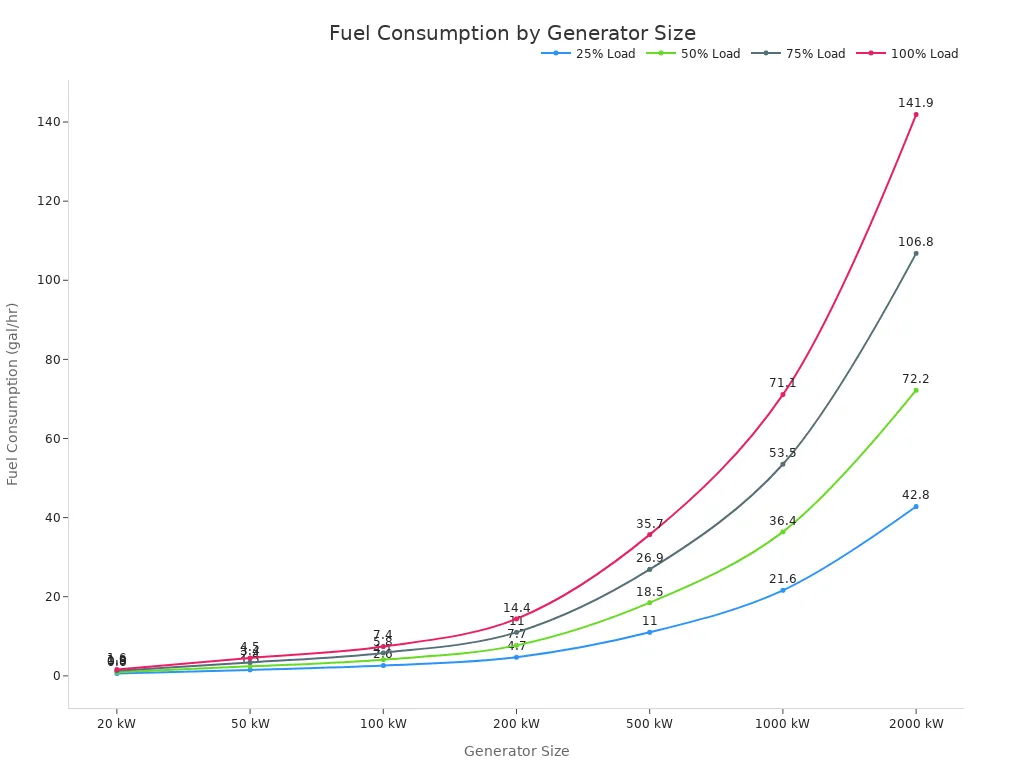
Fuel use rises with load. A 100 kW unit burns about 2.6 gal/hr at 25% load and 7.4 gal/hr at full load. A 500 kW unit ranges from 11 to 35.7 gal/hr. Use a simple rule: gallons per hour ≈ actual load kW × 0.07. Modern gensets produce roughly 13–15 kWh per gallon. Efficiency peaks near 70–80% of rated capacity.
Plan your fuel supply before you buy. Lehui helps you match tank capacity to your required runtime.
Store diesel on site to control reserves and refueling schedules.
Add a tank, a fuel management program, and periodic quality checks, because stored diesel degrades over time.
Verify tank capacity and refueling access when you size for runtime.
Plan refueling logistics for extended outages.
Diversify sourcing to offset price volatility and supply disruptions.
Purchase price is only one line on the ledger. A complete cost picture protects your budget and your uptime.
Generator size drives the sticker price more than any other factor. Expect to pay roughly $16,500–$82,000 for a mid-size unit (50–200 kW), $88,000–$275,000 for large commercial models (250–750 kW), and $550,000 or more for industrial units above 1,000 kW. Lehui publishes transparent pricing across its range, so you can compare models without hidden fees.
|
Generator Size |
Typical Application |
2026 Price Range |
|---|---|---|
|
Mid-Size (50–200 kW) |
Small businesses, schools, clinics |
$16,500–$82,000 |
|
Large Commercial (250–750 kW) |
Hospitals, hotels, manufacturing |
$88,000–$275,000 |
|
Industrial (1,000+ kW) |
Data centers, mining, large industry |
$550,000+ |
Installation often matches or exceeds the equipment price. A $100,000 generator may demand $80,000–$150,000 in installation work. Budget for these line items:
Automatic transfer switch (400A–3000A): $2,000–$15,000+
Concrete pad: $2,500–$5,000 for a 500 kW unit
Electrical labor: $5,000–$25,000
Fuel infrastructure: $3,000–$10,000
Rooftop placements add $15,000–$50,000 in crane and rigging costs. Underground diesel tanks run $25,000–$50,000 installed.
Fuel and service costs accumulate every year. Planned maintenance runs $300–$500 annually for a 20 kW unit and $3,500–$6,000+ for models above 500 kW. Common repairs include injector replacement ($1,500–$3,500) and alternator failure from wet stacking ($3,000–$8,000+). Higher-efficiency designs cut fuel use but add maintenance complexity. Lehui balances both through robust engine design and accessible service points.
Site planning determines whether your generator runs reliably for years or fights its environment every day. Lehui provides site-planning support with every industrial unit, and you should settle these three areas before delivery.
Give the unit room to breathe and room to service. NFPA 110 calls for at least 3 ft of clearance at the front and sides, and NFPA 37 requires 5 ft from openings and combustible walls. Keep 36 in. in front of all serviceable parts.
Ventilation does two jobs: it feeds combustion air and it cools the room. Poor airflow causes overheating, head-gasket damage, power loss, and carbon monoxide buildup. Place exhaust fans high, above the generator, and use 45-degree bends instead of 90-degree bends to cut energy loss. Route ducted exhaust outside and keep it at least 10 ft from any building opening or air intake.
Air flow is a key major factor for indoor installations. There should be an exhaust fan on a thermostat to cool down after shutdown; all air dampers should open on power failure. On more than one occasion, the dampers were powered open and the operators didn't have enough torque to push against the generator radiator fan.
Unsoundproofed diesel sets typically produce 75–90 dB, a level that draws complaints in urban settings. Check your local limits first. Typical developed-country rules allow 45–55 dB(A) in residential zones during the day and 55–65 dB(A) in commercial zones, and California ordinances carry penalties for violations.
Soundproofed sets using acoustic enclosures, vibration isolation, and low-noise engine design can run as low as 50–60 dB. Sound-attenuating enclosures cut noise by up to 40 dB(A). Remember the distance rule: doubling your distance from the generator drops noise by 6 dB. Lehui offers factory acoustic enclosures that meet strict municipal limits without sacrificing service access.
Wire the installation to code and document every step. NFPA 70 (NEC) Articles 445, 700, and 701 govern wiring, overcurrent protection, and generator integration. NFPA 110 sets testing and maintenance protocols for standby systems. OSHA 29 CFR 1926.404(f)(3) requires full NEC grounding whenever the generator connects to a structure's wiring.
Keep the run between generator terminals and the first overcurrent device as short as possible. Use flexible conduit and stranded wire to absorb vibration. Size battery cables to minimize voltage drop, and connect the battery charger to the starter solenoid positive and the frame negative. Engage a qualified electrician, obtain permits, and confirm compliance with local building, environmental, and electrical codes before energizing the system.
A generator only delivers reliable power when someone maintains it properly. You need a clear service plan, a dependable support network, and warranty terms you understand before you sign.
Manufacturers recommend a tiered schedule of weekly, monthly, semiannual, and annual tasks. Your usage pattern and operating environment set the exact intervals.
|
Service Type |
Recommended Interval |
|---|---|
|
Annual checkup |
Once per year for all generator types |
|
Operation-hours service |
Every 100–200 hours for higher usage |
|
Manufacturer's schedule |
Per generator manual recommendations |
NFPA 110 mandates weekly inspections for Level 1 emergency power systems serving critical facilities, though most maintenance professionals recommend weekly protocols for all commercial and industrial generators regardless of classification.
Confirm that your dealer stocks common parts locally. A two-day wait for a fuel filter becomes a two-day outage.
A strong support network keeps your unit running. Look for these capabilities when you evaluate a supplier:
Preventive maintenance: scheduled inspections, fluid changes, and filter replacements at planned intervals.
Predictive maintenance: sensor and performance-trend data used to intervene before a failure occurs.
Reliability-centered maintenance: prioritizes tasks that directly support uptime and safety for the specific application.
Remote monitoring and IoT sensors: feed real-time data to the maintenance team to enable proactive service.
Lehui backs its industrial generators with factory-authorized technicians and responsive on-site service.
Read the warranty before you buy. Coverage varies widely across manufacturers.
|
Warranty Aspect |
Typical Terms & Coverage |
|---|---|
|
Duration |
Varies by manufacturer; some end after a set number of years, others after a set number of operating hours |
|
Component Coverage |
Ranges from major components only (engine, alternator) to full protection including auxiliary systems |
|
Common Exclusions |
Wear items (belts, hoses, batteries); damage from dirty fuel or improper storage; unauthorized repairs |
|
Maintenance Conditions |
Warranty validity often requires adherence to service plans and documented maintenance intervals |
Standard warranties typically cover only the first year of operation. Extended warranties can continue protection against costly repairs. Lehui offers clear warranty terms and genuine parts support for every industrial unit.
You have your load profile, your size, and your budget. Now verify the unit itself. These final checks protect your investment and close out this industrial diesel generator buying guide.
Start with the hour meter, but never judge a unit by hours alone. Follow this sequence:
Review the hour meter reading against the unit's visible condition, checking for oil leaks, corrosion, and worn hoses.
Request service records for oil changes, filter replacements, coolant service, and repairs.
Ask for load test reports or an operating demonstration to confirm voltage stability and cooling response.
Verify the operating history, whether standby, prime, rental, or continuous industrial duty.
|
Hour Range |
Implication |
Inspection Focus |
|---|---|---|
|
Under 2,000 hours |
Near-new condition, premium pricing |
Confirm exercise and maintenance during storage; check fuel varnishing and battery health |
|
2,000 to 6,000 hours |
Optimal value, most service life remains |
Review routine maintenance records and load testing history |
|
Above 8,000 to 10,000 hours |
High-hour category, approaching major service |
Assess overhaul history, cylinder head work, and remaining service life |
Used units offer lower upfront cost and strong value when records are complete. Diesel engines typically deliver 10,000–20,000 hours before major overhaul, and well-maintained units exceed 30,000 hours. A unit with 5,000 documented hours and full service records represents excellent value. Unknown history or 15,000+ hours demands careful technical assessment.
New units bring the latest controllers, better load management, and 10–15% lower fuel consumption. Surplus units sit between the two: near-new hours, prices above used but below new, and sometimes remaining factory warranty.
|
Factor |
New Generators |
Used Generators |
|---|---|---|
|
Upfront Cost |
Higher, includes newest features |
Lower, budget-friendly |
|
Warranty |
Manufacturer coverage included |
Varies by age, condition, and supplier |
|
Technology |
Latest controls and monitoring |
Older controls, still reliable when maintained |
|
Long-Term Value |
Longer service life, predictable performance |
Strong value when condition is verified |
Lehui supplies both new and certified pre-owned industrial units with documented service histories.
Remote monitoring turns reactive repairs into planned service. Confirm these capabilities before you buy:
Fuel level sensors with 4–20 mA inputs for accurate tank readings
Battery voltage, temperature, and pressure sensors for early fault detection
Data transmission via cellular IoT, satellite, or hardwired connection
ECM-based monitoring through MODBUS or J1939 protocols
Cloud or on-site access with updates in under five seconds
Modern digital panels interface directly with the engine control module. Older analog units need an A-to-D converter and a specialty harness. Lehui industrial generators ship with advanced control panels and remote gateway support, so your team sees faults before they become outages.
Match your power needs, sizing, costs, installation, and support to secure a sound purchase. This industrial diesel generator buying guide shows that thorough pre-purchase evaluation protects uptime and long-term ROI — facilities tracking maintenance report 28 to 40 percent lower costs. Consult a qualified dealer and request a tailored quote using this industrial diesel generator buying guide.
Build a complete load list in kW and kVA. Apply a diversity factor, add your largest motor's starting surge, and include 20–25% headroom. Lehui engineers can verify your load profile before purchase.
Diesel delivers higher energy density and stronger performance under spiking loads. Natural gas works well for steady duty with pipeline access. Match your choice to load profile, fuel access, and runtime needs.
Follow a tiered schedule: weekly inspections, service every 100–200 operating hours, and an annual checkup. Confirm local parts availability and factory-authorized technicians before you buy.
 NO.2 XIAHE ROAD GANZHE STREET,MINHOU COUNTY,FUZHOU FUJIAN CHINA
Please read on, stay posted, subscribe, and we welcome you to tell us what you think.


Copyright @ 2026 LEHUI (FUZHOU) INTELLIGENT EQUIPMENT MANUFACTURING CO., LTD All Rights Reserved.
 Network Supported
 English
 français
 Deutsch
 italiano
 русский
 español
 português
 العربية
 Melayu
 Indonesia

