
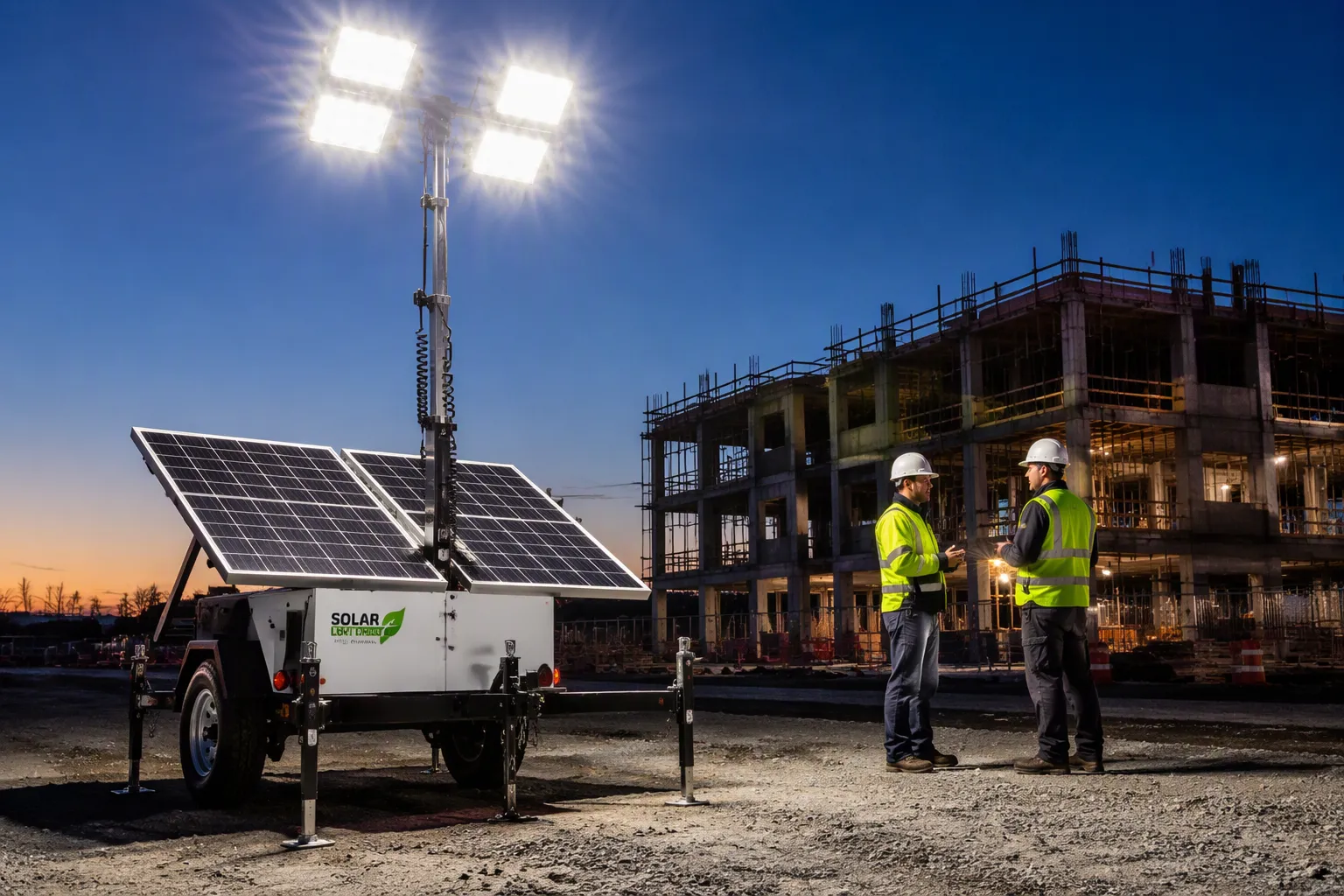
To pick a Solar LED Light Tower for zero emission site lighting, you must focus on four core specs: solar panel wattage, battery capacity, LED lumen output, and durable construction. Match these specs to your site's area size, brightness needs, and nightly runtime. Prioritize verified zero emission models without backup fuel generators. Confirm portability, weather resistance, and budget fit before buying. Consider LEHUI solar LED light towers, which combine high-efficiency solar panels, lithium battery storage, and rugged construction for reliable zero emission performance.
Measure your site’s area, brightness, and nightly runtime first. Use those numbers to match solar wattage and battery capacity.
Choose a zero emission model with high-efficiency solar panels and lithium iron phosphate batteries. This pairing supports several cloudy nights.
Confirm strong weatherproofing and wind ratings before purchase. A durable solar tower saves thousands over its lifetime.
Before you compare models or request quotes, you need a clear picture of what your site actually requires. A solar LED light tower performs best when its core components match your specific lighting task. You should work through four planning steps: calculate your area and brightness needs, define how long the lights must run each night, evaluate solar panel wattage, and choose the right battery type and capacity.
Start with the physical space you need to illuminate. Measure the length and width of your work zone in feet or meters. A larger area demands more lumens and often a taller mast to spread light evenly. Mast height directly affects coverage. A taller mast pushes light farther across the site, but it also reduces the intensity that reaches the ground. You must balance height against the brightness your tasks require.
Brightness requirements depend on the type of work you perform. OSHA and IES provide recommended illuminance levels for different construction tasks. Use the following table as your reference:
|
Construction Lighting Task |
Foot-Candles |
Approx. Lux |
|---|---|---|
|
General construction site work surface |
5 |
54 |
|
General construction plant and shops |
10 |
108 |
|
Outdoor construction site |
5 to 10 |
54 to 108 |
|
Concrete placement and excavation operations |
3 |
33 |
|
Indoor construction / building interiors |
5 |
54 |
|
Underground or tunnels |
5 |
54 |
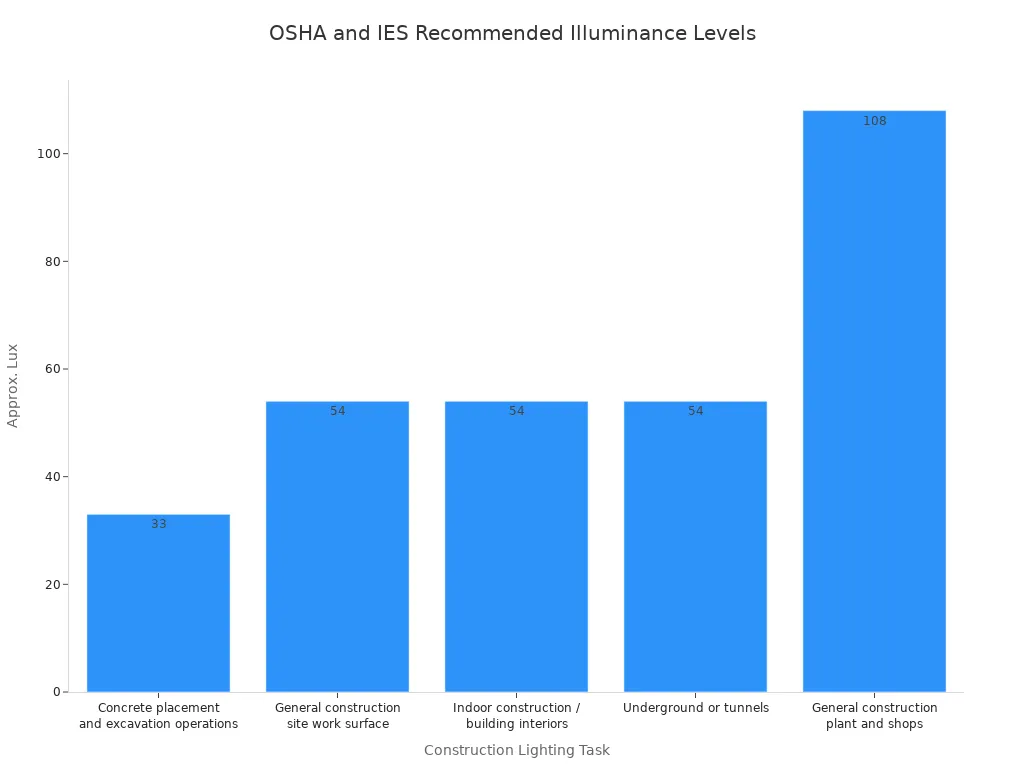
General construction areas require a minimum of 5 foot-candles of illumination, and plants and shops require at least 10 foot-candles.
These values translate to roughly 54 lux and 108 lux. You can see how the recommended levels shift across common tasks in the chart below.
Match your mast height and fixture output to these targets. A site that needs 10 foot-candles across a wide area will require a different configuration than a tunnel job that needs focused, consistent light at 5 foot-candles.
Nightly runtime is the number of hours your lights must operate between dusk and dawn. Most construction sites run lights for 10 to 12 hours per night. Some operations need 24-hour coverage, which changes your power calculations dramatically. Write down your required runtime before you evaluate any product.
Backup needs address weather and seasonal challenges. Solar charging depends on sunlight, so consecutive cloudy or rainy days reduce your available power. A well-designed solar LED light tower should support multiple days of autonomy. One common benchmark is the ability to run for up to 4 consecutive rainy or cloudy days without recharging from the sun.
Consider a system with a standard 19.2kWh battery. This capacity provides approximately 38 hours of runtime for lighting alone when fully charged. That translates to roughly three to four nights of typical 10- to 12-hour operation. If your site faces extended overcast periods, you may need a larger battery bank or an optional fuel generator for extreme conditions. However, adding a fuel generator compromises the zero emission goal. You should size your battery to avoid that trade-off whenever possible.
Solar panels act as the energy collectors for your entire system. They use photovoltaic cells to convert sunlight into DC electricity. Monocrystalline and polycrystalline panels are the two most common types. Monocrystalline panels generally deliver higher efficiency, especially in low-light conditions. Polycrystalline panels cost less but require more surface area for the same output.
Panel wattage determines how quickly your system recharges. A higher wattage panel refills the battery faster and supports more daily energy consumption. You should calculate your daily energy need first. Multiply your LED wattage by your nightly runtime. For example, a 300-watt LED fixture running 12 hours consumes 3,600 watt-hours per night. Your solar panel must generate at least that amount each day, plus extra to account for charging losses and cloudy weather.
A charge controller regulates electricity flow among the panels, battery, and lights. It prevents overcharging and over-discharging. The controller also maintains optimal voltage and current. A high-quality controller extends battery life and protects your investment. When you compare solar LED light tower models, check the panel wattage and controller type together. A powerful panel paired with a weak controller wastes energy and shortens battery lifespan.
The battery bank stores the electricity your panels generate during the day. It releases that power at night or during cloudy periods. Battery type and capacity are the most critical factors for reliable zero emission performance.
Lithium iron phosphate (LiFePO4) batteries dominate solar light tower designs. They offer high energy density, long lifespan, and low self-discharge. Lead-acid batteries (AGM or Gel) remain an older, cheaper alternative. The differences between these two types are substantial:
|
Attribute |
LiFePO4 (Lithium Iron Phosphate) |
Lead-Acid (AGM/Gel) |
|---|---|---|
|
Typical cycle life |
2,000–5,000 cycles |
300–1,200 cycles |
|
Typical usable depth of discharge |
80%–90% |
40%–60% |
A properly managed LiFePO4 battery may deliver roughly 2,000–5,000 cycles. That equals about five to twelve years in daily lighting use. A lead-acid battery typically provides only 300–1,200 cycles, or about one to four years, especially if you regularly discharge it below 50%. In terms of usable capacity, a lead-acid battery is often limited to about 50% of its rated capacity. A LiFePO4 battery can typically use 80%–90% of its rated capacity. This means a smaller lithium battery can sometimes match the runtime of a larger lead-acid battery.
Capacity is measured in kilowatt-hours (kWh). You should size your battery to cover your nightly runtime plus at least one to two days of backup. A larger battery adds weight and cost, so you must balance autonomy against portability. Smart solar light towers with remote monitoring and automated dimming help you manage battery health and optimize runtime. These features are creating premium demand in fleet management applications.
When you evaluate a solar LED light tower, look for a model that pairs high-efficiency monocrystalline panels with a robust LiFePO4 battery bank and an intelligent charge controller. LEHUI designs its towers around this exact combination, delivering reliable zero emission lighting across harsh climates and remote terrain.
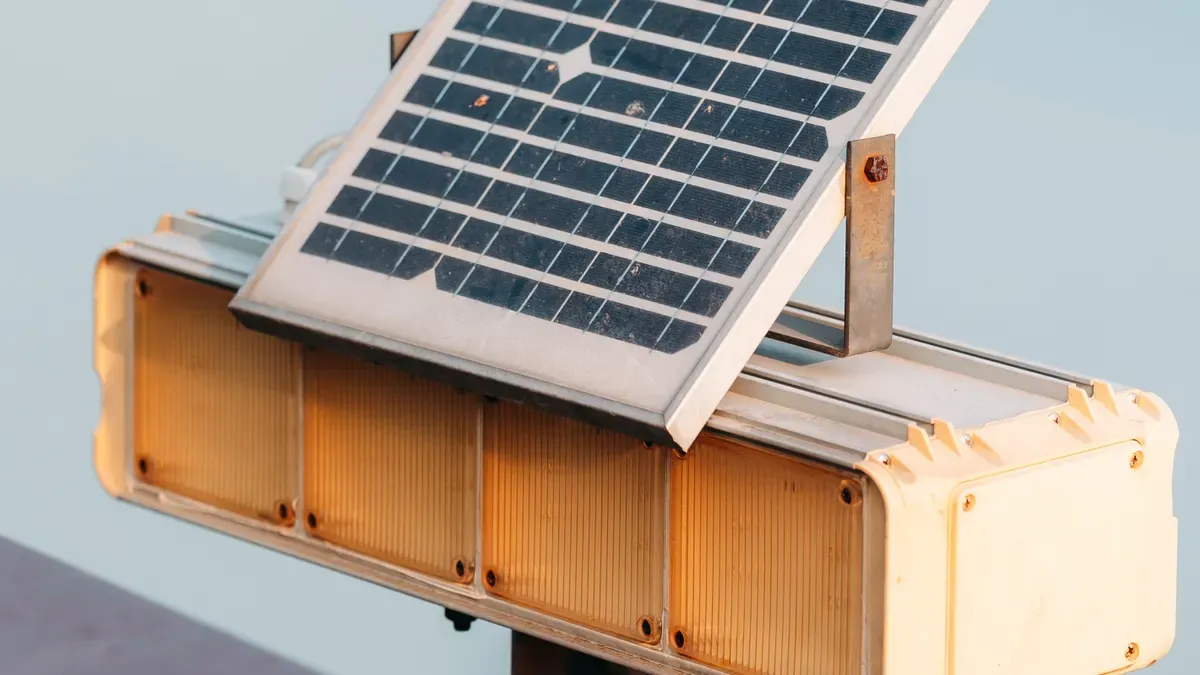
You have already matched solar panel wattage and battery capacity to your site requirements. Now you must confirm that the LED fixtures convert stored energy into useful light efficiently and durably. LED performance determines visibility. Durability determines your return on investment. This section examines these factors in detail. It also helps you select a solar LED light tower that survives demanding conditions.
Lumen output measures the total visible light your fixtures emit. Higher lumen values deliver brighter illumination across the work zone. Efficacy deserves equal attention. It defines the number of lumens generated per watt of electricity consumed. High efficacy means the system produces more light while draining less battery power. Compare efficacy figures when evaluating any model.
The table below displays current high-efficacy benchmarks across commercial product series:
|
Product Series |
Efficacy (Lm/W) |
|---|---|
|
SATELIS PRO Series |
Up to 200 Lm/W |
|
HYBRID Dual-Power Series |
200 Lm/W Engine |
|
SUNLIKE PRO Series |
190+ Lm/W |
|
ORINDA PRO Series |
185 Lm/W |
One commercial manufacturer explains the impact of this efficiency standard clearly:
Premium Lumileds LED chips packaged into custom SMT arrays, driven by low-loss constant-current LED drivers, deliver up to 200 Lm/W real-world system efficacy. This performance allows commercial solar LED fixtures to achieve bright, uniform illuminance (foot-candles) while consuming a fraction of stored battery energy. The result is a drastic reduction in required solar panel surface area.
Color temperature also affects worker performance. You measure this specification in Kelvin (K). A 3000K setting produces warm yellowish light. A 5700K setting produces cool bluish-white light. Construction sites perform best with neutral white light between 4000K and 5000K. This range enhances visibility, reduces eye strain, and improves color recognition for workers inspecting materials. Manufacturers such as LEHUI combine high-efficacy LED chips with smart drivers to deliver this optimal color range while minimizing battery draw.
Beam spread describes how light distributes across the ground. Narrow-beam fixtures concentrate illumination in tight areas. Wide-beam fixtures spread luminance across large surfaces at lower intensity. Your application dictates the correct pattern.
Most models feature multiple adjustable fixtures on a single mast. You can rotate each fixture independently to aim light where needed. Some models accept interchangeable lenses. Symmetric lenses work well for general site lighting. Asymmetric lenses suit roadworks or linear construction zones. Verify that the manufacturer offers the lens types your site requires.
Mast height also influences coverage. A standard 25-foot mast with four 150-watt fixtures illuminates roughly 3,000 to 5,000 square feet adequately. Raising the mast to 32 feet expands the coverage area significantly. Ground-level brightness decreases with added height. Balance coverage area against luminance requirements using the foot-candle targets you established earlier. Always request photometric reports from the manufacturer. These reports show illuminance distribution at various mounting heights. You can then verify that the beam pattern matches your site's measured dimensions.
Outdoor lighting equipment faces dust, rain, salt, and wind. IP (Ingress Protection) ratings classify resistance levels. An IP65 rating protects against dust and low-pressure water jets. An IP66 rating withstands powerful water jets. Choose a solar LED light tower with fixtures and electrical enclosures sealed to at least IP65 for reliable outdoor service.
Wind resistance represents a second critical durability factor. Most commercial coastal and high-wind construction sites require lighting poles rated for 90 to 110 mph winds. Hurricane-prone zones demand ratings of 150 mph or higher. The American Association of State Highway and Transportation Officials (AASHTO) sets U.S. wind-zone requirements. Standards range from 90 mph to 170 mph. Match your mast rating to your local wind zone. Some manufacturers, such as Greenshine, specify wind resistance up to 150 mph with corrosion-resistant finishes. These units suit coastal zones and high-wind environments well.
Mounting options also affect durability and site flexibility. Trailer-mounted towers provide maximum mobility. Skid-mounted units allow forklift handling and stable placement on uneven ground. Fixed-pole installations serve long-term projects. Evaluate how each mounting style matches your terrain and project duration.
Portability determines how quickly your crew can relocate lighting between job sites. Mobile towers mount on trailers with single-axle configurations. Review the specifications that affect towing safety and ease. The table below shows typical specifications for a single-axle mobile tower:
|
Specification |
Detail |
|---|---|
|
Gross Weight |
1180 kg |
|
Axle Configuration |
Single axle |
|
Brakes |
Without brakes |
|
Suspension |
Leaf spring suspension |
|
Tire Size |
14-inch standard/regular tires |
|
Drawbar |
Traction bar with retractable guide wheels |
|
Drawbar Head |
2" or 50 mm ball puller |
|
Support Legs |
4 manual support legs with retractable support rods |
|
Taillights |
Tail reflector (for safe night towing) |
|
Maximum Towing Speed |
80 km/h (62 mph) |
|
Operational Dimension |
3200 × 1630 × 2750 mm |
|
Shipping Dimension |
2200 × 1630 × 2330 mm |
Check the maximum towing speed against your vehicle and planned routes. Verify whether the tower requires brakes at your highway travel speed. Confirm the drawbar head size matches your hitch receiver. Tire size affects ground clearance and towing stability on rough terrain. Verify that the unit can navigate your site's access roads. Retractable guide wheels improve maneuverability during positioning. Four manual support legs stabilize the unit on uneven terrain.
Mast raising mechanisms differ between models. Manual mechanisms require physical effort and extra setup time. Hydraulic systems raise the mast with a button push. Multi-site crews gain significant time savings from hydraulic operation. Evaluate your crew size and workflow when choosing between these options.
You can now move to the final step after validating LED performance and durability. That step involves confirming zero emission certification, comparing costs, and reviewing smart features.
You have matched components and verified LED performance. Now you must confirm true zero emission operation, calculate your financial return, and select smart features that serve your site.
A genuine zero emission solar LED light tower produces no exhaust, no carbon dioxide, and no particulate matter during operation. You should request documentation that confirms zero on-site emissions. Many government contracts and urban tenders now require "Zero Emission" or "Low Noise" equipment. This requirement makes solar-powered towers a competitive advantage in the bidding process. Noise restrictions in residential areas or night work often mandate silent solar units. These regulations directly influence your feature selection.
Solar light towers cost more upfront than diesel models. The long-term savings justify the investment. Review the annual operating cost differences:
|
Cost component |
Diesel light tower |
Solar LED light tower |
Estimated annual savings with solar |
|---|---|---|---|
|
Fuel |
US$3,000–US$8,000 or more per year |
Essentially zero direct fuel cost |
About US$3,000–US$8,000+ in avoided fuel |
|
Maintenance |
Approximately US$1,000–US$2,500 or more per year |
Approximately US$200–US$500 per year |
Roughly US$500–US$2,300+ in avoided maintenance |
|
Combined fuel + maintenance |
High recurring annual operating cost |
Low recurring annual operating cost |
Approximately US$4,000–US$6,000 per year |
A source on solar light towers for mining states that the 30% federal Investment Tax Credit reduces upfront costs, enabling the payback period to be as short as 12–18 months.
Smart features extend battery life and reduce waste. Adaptive dimming lowers light output when full brightness is unnecessary. Motion sensors activate lighting only when workers enter an area. Remote control allows you to adjust settings from a distance. Timers automate dusk-to-dawn operation. These features create premium demand in fleet management applications.
Your site conditions determine which features matter most. Consider these differences:
|
Feature / Consideration |
Mining operations |
Highway road construction projects |
|---|---|---|
|
Chassis & towing |
Heavy-duty off-road trailer with reinforced frame and high ground clearance |
Highway-legal towable models plus compact push-cart variants |
|
Durability & weather resistance |
Mining-grade anti-corrosion coating; IP65 rated; typhoon-level wind resistance |
Weatherproof masts rated at 117 km/h wind for exposed bridge settings |
|
Power & energy |
Wind + solar hybrid option for remote, high-altitude locations |
Solar-powered units for nighttime traffic management zones |
|
Lighting & coverage |
Bright output for large remote work areas |
Portable units with 7 m masts lighting up to 3,200 square meters |
Mining operations need remote-area lighting, less fuel transport, and deployment in rough terrain. Road and highway projects need traffic management zone lighting, road repair support, and bridge construction illumination. A well-matched solar LED light tower delivers reliable performance for either application.
Calculate your site's area, brightness, and runtime needs. Match solar panel wattage and battery capacity to those requirements. Verify LED lumens, color temperature, and beam spread. Confirm durable construction and zero emission operation. Weigh upfront cost against long-term savings—solar towers can save over $300,000 compared to diesel over time. A well-matched solar LED light tower, such as a LEHUI model, delivers reliable lighting with minimal operating costs.
You need enough lumens to hit 5 to 10 foot-candles across your work zone. A 300-watt LED fixture typically delivers sufficient brightness for most general construction tasks.
Yes. Choose a model with a large LiFePO4 battery bank. A 19.2kWh battery provides roughly three to four nights of backup power without sunlight.
Match the mast rating to your local wind zone. Coastal and high-wind sites need poles rated for 90 to 150 mph. Check AASHTO standards for your region.
 NO.2 XIAHE ROAD GANZHE STREET,MINHOU COUNTY,FUZHOU FUJIAN CHINA
Please read on, stay posted, subscribe, and we welcome you to tell us what you think.


Copyright @ 2026 LEHUI (FUZHOU) INTELLIGENT EQUIPMENT MANUFACTURING CO., LTD All Rights Reserved.
 Network Supported
 English
 français
 Deutsch
 italiano
 русский
 español
 português
 العربية
 Melayu
 Indonesia

